Why Do Vietnamese Dragon Fruit Farmers Use Artificial Lighting at Night?
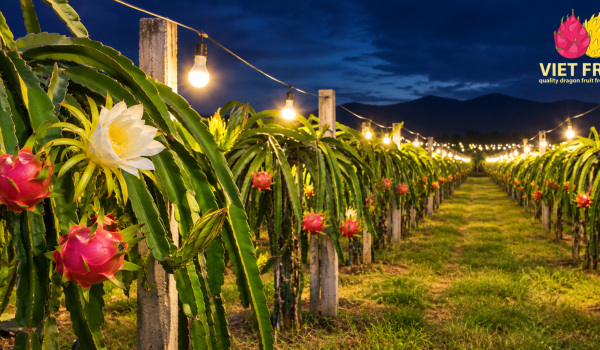
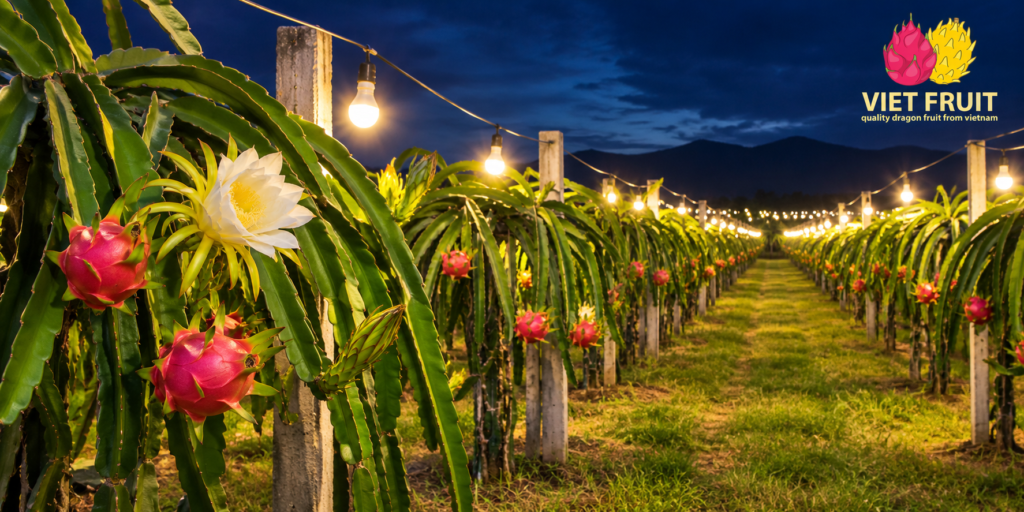
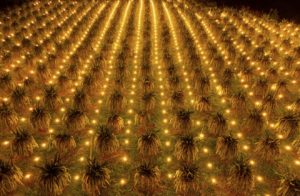
If you travel through Vietnam’s dragon fruit-growing regions after sunset, particularly in provinces such as Binh Thuan and Long An, you may notice something unusual. Thousands of small lights illuminate the plantations, creating the appearance of a brightly lit landscape.
However, these lights are not installed for decoration. Vietnamese dragon fruit farmers use artificial lighting at night to stimulate flowering, extend the harvesting season and maintain production during periods when natural daylight is insufficient.
This agricultural technique plays an important role in Vietnam’s dragon fruit industry. Moreover, it allows farmers and exporters to plan production more effectively and supply international markets beyond the traditional harvesting season.
For international importers working with a Vietnamese dragon fruit exporter, understanding this technique provides valuable insight into seasonal availability, production volumes and fruit quality.
Why Do Vietnamese Dragon Fruit Farmers Use Lights at Night?
Dragon fruit (Hylocereus species) is a photoperiod-sensitive plant. This means that its flowering behaviour is influenced by the length of daylight and darkness.
Under natural conditions, dragon fruit generally flowers during periods with longer days. In Vietnam, the main natural production season typically runs from spring through early autumn. However, when daylight hours become shorter, flowering can become limited.
Consequently, farmers use artificial lighting to extend the perceived daylight period.
By illuminating their plantations during the night, growers can stimulate the development of flower buds and encourage additional fruit production outside the main harvesting season.
This technique is commonly known as artificial light-induced flowering or photoperiodic lighting.
It is particularly important in Vietnam’s southern dragon fruit-growing regions, where farmers want to maintain production during the cooler months and prepare additional harvests for periods of strong market demand.
How Does Artificial Night Lighting Work?
 The principle behind nighttime lighting is relatively straightforward. Artificial light influences the plant’s response to day length and helps trigger the flowering process.
Farmers install lamps between the dragon fruit planting rows, positioning them to provide sufficient light across the growing area.
Depending on the farming region, variety, season and lighting system, the lamps may operate for several hours during the night.
Traditional farming methods used incandescent bulbs. However, many growers have gradually moved towards more energy-efficient compact fluorescent lamps (CFLs) and LED lighting systems.
The lighting programme is carefully managed because both the duration and intensity of illumination can influence flowering performance.
A typical production cycle involves several stages:
Nighttime illumination: Farmers provide additional artificial light to stimulate flowering.
Flower bud development: After the lighting programme ends, flower buds begin to develop.
Flowering and pollination: The flowers open, usually at night, and pollination takes place.
Fruit development: Successfully pollinated flowers develop into dragon fruit.
Harvesting: Depending on growing conditions and variety, the fruit is generally ready for harvesting approximately 55–60 days after the lighting programme ends.
Importantly, the exact timing depends on the variety, weather conditions, plant health and farming practices.
Therefore, artificial lighting is not simply a matter of switching on lamps. It requires careful crop management and experience.
How Does Nighttime Lighting Increase Dragon Fruit Production?
One of the biggest advantages of artificial lighting is its ability to extend the production season.
Without additional lighting, farmers would depend more heavily on natural flowering cycles. This would create a more concentrated harvesting season and reduce the availability of fresh dragon fruit during certain months.
However, by stimulating additional flowering cycles, growers can produce fruit outside the main natural season.
This offers several advantages:
Extended harvesting periods
Farmers can schedule additional harvests throughout the year rather than relying exclusively on the natural production season.
Higher annual production potential
Additional flowering cycles can increase the total number of harvests and the annual production volume per hectare, provided that the plants have sufficient resources and are managed correctly.
Better production planning
Growers can organise different sections of their plantations to flower at different times. Consequently, harvesting and packing activities can be distributed over a longer period.
Improved market availability
Additional production helps exporters maintain supply during periods when naturally available dragon fruit volumes are lower.
For international buyers, this means that Vietnamese dragon fruit can remain available during more months of the year.
Does Artificial Lighting Affect Dragon Fruit Quality?
An important question for international importers is whether nighttime lighting changes the quality of the harvested fruit.
 The short answer is that artificial lighting primarily influences flowering and production timing. It does not automatically improve or reduce the quality of the dragon fruit.
When properly managed, light-induced flowering can produce commercially marketable fruit with the expected characteristics of its variety.
However, several other factors determine the final quality.
Fruit size and weight
Fruit size depends on several factors, including plant nutrition, irrigation, pollination, fruit load and growing conditions.
When plants carry too many developing fruits, competition for nutrients can affect individual fruit development. Therefore, careful crop management is important to maintain the required commercial sizes.
Skin appearance and colour
The external appearance of dragon fruit depends on variety, maturity, sunlight exposure and growing conditions.
Farmers must ensure that fruit develops properly before harvesting. This is particularly important for exporters supplying supermarkets and premium fresh fruit distributors.
Flesh quality and sweetness
The sweetness, texture and internal quality of dragon fruit are influenced by fruit maturity, variety, growing conditions and harvesting practices.
Artificial lighting itself should not be considered a guarantee of higher sweetness or better internal quality.
Shelf life and transportation performance
For international shipments, post-harvest handling is just as important as production practices.
Harvest maturity, careful sorting, suitable packaging, phytosanitary treatments and temperature management all contribute to maintaining fruit quality during transportation.
Consequently, the quality of an export shipment depends on the complete supply chain, not simply the lighting programme used on the farm.
Why Lighting Schedules Matter for International Importers
For importers, wholesalers and supermarket distributors, the greatest commercial advantage of nighttime lighting is improved production flexibility.
Vietnamese farmers can stagger their lighting programmes across different sections of their plantations. Instead of stimulating all their dragon fruit plants simultaneously, they can organise several production cycles.
This helps distribute harvesting volumes over time and reduces the risk of concentrating the entire crop within a short period.
For example, one group of plantations can be prepared for harvesting in December, while another group is scheduled for January or February.
This approach is particularly useful when planning shipments around international retail programmes, seasonal demand and major holidays.
However, additional production does not mean that unlimited volumes are available at any time.
Weather conditions, electricity costs, farm management, fruit development and market demand all influence the final quantity available for export.
Therefore, international buyers should communicate their expected volumes and delivery schedules with their Vietnamese dragon fruit supplier well in advance.
Energy-Efficient Lighting and More Sustainable Production
Although artificial lighting offers important production advantages, electricity consumption has historically been a major operational cost for dragon fruit farmers.
 Traditional incandescent bulbs consume considerable amounts of electricity, particularly when thousands of lamps operate across large plantations.
For this reason, Vietnam’s agricultural sector has increasingly explored energy-efficient alternatives.
Compact fluorescent lamps and specialised LED systems can reduce electricity consumption while maintaining effective flowering stimulation.
Research conducted in Vietnam has demonstrated that specially designed lower-energy lighting systems can achieve promising flowering results compared with traditional incandescent lamps.
This development is important for several reasons:
Lower electricity consumption per lighting cycle.
Reduced production costs for farmers.
More efficient use of energy in agricultural production.
Potential reductions in the environmental footprint of dragon fruit cultivation.
Furthermore, improved energy efficiency can help Vietnamese growers remain competitive in international markets while supporting more responsible agricultural practices.
What Does This Mean for Vietnamese Dragon Fruit Exports?
For international importers, nighttime lighting is an important part of Vietnam’s ability to supply fresh dragon fruit beyond its main natural harvesting season.
It helps Vietnamese dragon fruit farmers manage flowering, extend production periods and plan additional harvesting cycles.
As a result, professional exporters can work with growers to coordinate expected production volumes, harvesting schedules and packing requirements more effectively.
Nevertheless, consistent export quality requires much more than sufficient production volumes.
At Viet Fruit, we believe that quality starts at the farm and continues throughout the entire export process.
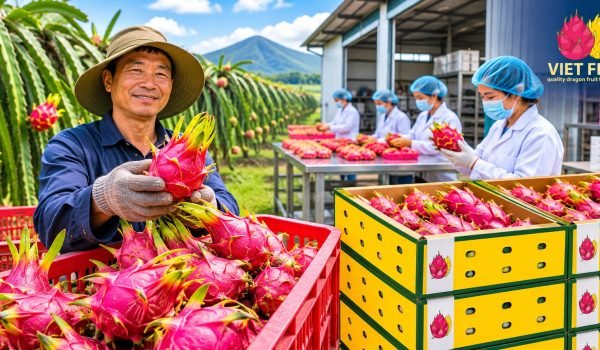
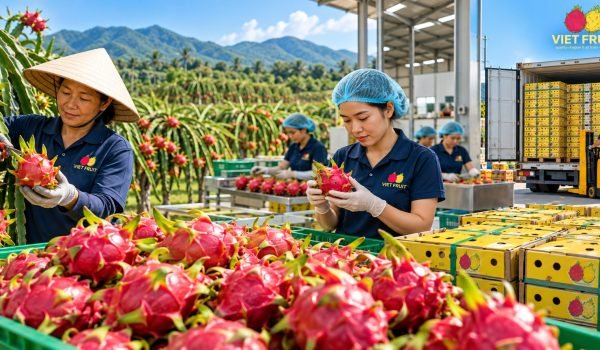
Through our network of experienced growers, we focus on careful harvesting, fruit selection, quality inspections, pesticide residue monitoring and professional export preparation.
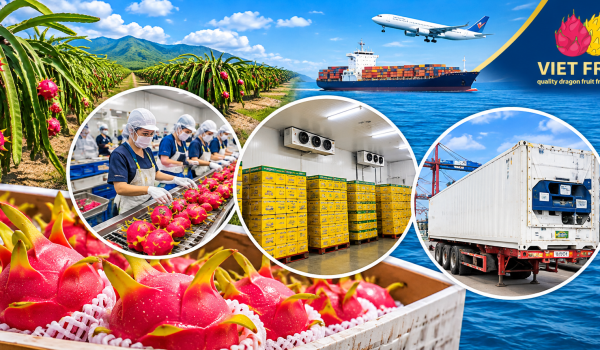
Furthermore, we pay close attention to packaging specifications, phytosanitary requirements and cold chain management to ensure that our Vietnamese dragon fruit meets the expectations of international customers.
Whether you are importing red, white, purple or yellow dragon fruit, reliable supply and consistent quality remain essential.
Working With a Reliable Vietnamese Dragon Fruit Exporter
Understanding how Vietnamese farmers use artificial lighting helps international buyers better understand the country’s production cycles and export opportunities.
However, successful sourcing also depends on choosing an experienced export partner who understands both agricultural production and international trade requirements.
At Viet Fruit , we work closely with selected growers and packing partners to supply fresh Vietnamese dragon fruit to importers, wholesalers, distributors and retailers worldwide.
Our focus is on consistent quality, reliable supply, careful handling and compliance with destination market requirements.
Are you looking for a reliable Vietnamese dragon fruit exporter?
Contact Viet Fruit to discuss available varieties, expected harvesting periods, export volumes, packaging specifications and pricing for your market.
Viet Fruit – Quality Vietnamese Dragon Fruit, from Farm to Customer.
Email: sales@viet-fruit-trading.com WhatsApp: +84 77 5055 568
Follow us on Facebook